
Process and Procedure
  1. Confidentiality

    Any information gained in the course of certification activities about a particular commodity or organization shall be treated as confidential, and it shall not be disclosed to a third party without the written consent of the organization. Where the law requires information to be disclosed to a third party, the organization shall be informed of the information to be provided as permitted by law.
  1. SABS manages impartiality through Six Pillars:

    1. Independent Certification Decision-Making
      Certification decisions are made using documented processes that are independent of commercial and operational interests.
    2. Independent Internal Oversight
      Accreditation and certification activities are reviewed through independent internal audits and oversight functions.
    3. Complaints and Appeals Analysis
      Complaints and appeals are analysed objectively to identify and address risks to impartiality.
    4. Stakeholder and Regulatory Feedback
      Regular surveys and engagement with stakeholders and regulators monitor confidence in SABS impartiality.
    5. Corporate Governance and Risk Oversight
      Impartiality risks are reviewed through internal audit and audit and risk committee structures.
    6. Financial Risk and Client Concentration Review
      Financial information is analysed to prevent impartiality risks arising from reliance on specific clients.

    SABS is also subject to bi-annual impartiality committee meetings with industry representatives. The procedure governing these processes is CrtSP 007: Terms of Reference of the Impartiality Mechanism for Certification Schemes.
  1. At SABS, we take all complaints and appeals seriously, ensuring they are handled with fairness, transparency, and impartiality. Our structured process allows stakeholders to raise concerns regarding certification decisions or any aspect of our services. Every submission is reviewed thoroughly, investigated appropriately, and responded to within a clear and defined timeframe.

    How SABS handles complaints

    1. Submission of a Complaint
      Any customer, stakeholder, or member of the public may submit a complaint about SABS services or processes.
    2. Registration and Acknowledgement
      The complaint is formally recorded in the SABS system and acknowledged to the complainant.
    3. Initial Review and Validation
      SABS evaluates whether the complaint is valid and determines the scope and potential impact.
    4. Investigation and Root Cause Analysis
      An assigned manager or independent investigator reviews the complaint, gathers information, and identifies the underlying cause.
    5. Corrective Action
      Actions are taken to address the issue and prevent it from happening again.
    6. Communication of Outcome
      A formal outcome report is issued to the complainant, including actions taken and conclusions.
    7. Closure and Monitoring
      The complaint is closed once actions are verified as effective. Complaint trends are reviewed by management to drive continual improvement.


    How SABS handles appeals

    1. Submission of an Appeal
      An appeal may be lodged by an organisation or individual affected by a certification, inspection, or proficiency testing decision.
    2. Registration of the Appeal
      The appeal is logged through the complaints system and tracked as an Improvement Request.
    3. Independent and Impartial Review
      An independent and competent team, not involved in the original decision, is appointed to investigate the appeal.
    4. Investigation and Root Cause Determination
      The investigation team reviews evidence, determines the root cause, and evaluates whether the original decision was appropriate.
    5. Corrective and Remedial Action
      Where necessary, corrective actions are implemented, and decisions may be amended or confirmed.
    6. Formal Response to the Appellant
      A written response is provided to the appellant explaining the outcome and supporting reasons.
    7. Timeframe and Oversight
      Appeals are finalised within 30 working days and are reported to management for oversight and monitoring.
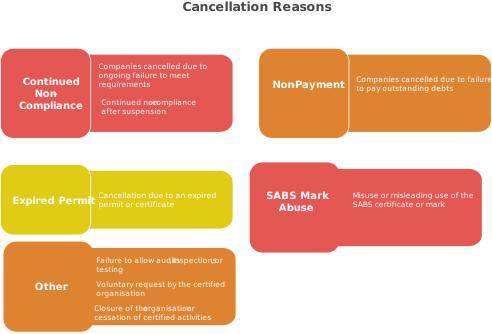
  1. The cancellation processes may happen under the following circumstances: cancellation processes
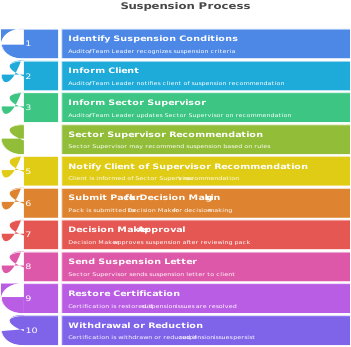
  1. The suspension processes may happen under the following circumstances: suspension processes